
A school fee challan generator is a tool that turns your fee heads, due date and bank details into a printable challan with bank, office and student copies. Free generators give you a blank template you fill in by hand; fee software creates a filled challan for every student from their records, with arrears and late fines already worked out.
Which one you need depends on how many students you bill and how often the amounts change. This guide shows what a challan must contain, where free templates stop working, and how to run a clean monthly challan cycle.
What is a school fee challan generator?
A fee challan generator is any tool that produces the payment slip parents take to the bank or the school counter. In Pakistan the usual layout is three copies on one sheet: the bank keeps one, the school's accounts office keeps one, and the parent keeps the student copy as proof once it is stamped.
There are three kinds of generator you will find when you search:
- Blank template generators. Sites such as OpenEduCat's fee challan generator build a three-part challan (bank, office and student copy) from your institute name, fee heads and bank details. That tool is written for Indian schools (it asks for an IFSC code and mentions CBSE and ICSE) and prints a SAMPLE watermark that cannot be removed.
- Design templates. Template.net's school voucher templates are editable designs for tuition, cash and school vouchers. None is a Pakistani fee challan, and you still type every name and amount yourself.
- Fee software. A school management system keeps each student's fee plan and generates every challan for a class or the whole school in one go, then records the payment against the same challan number.
Pakistani boards already work the second way. BISE Malakand, for example, lets students and institutions generate bank challans from the board's own records, which the board says helps with fee verification and reduces errors.
What must a school fee challan show?
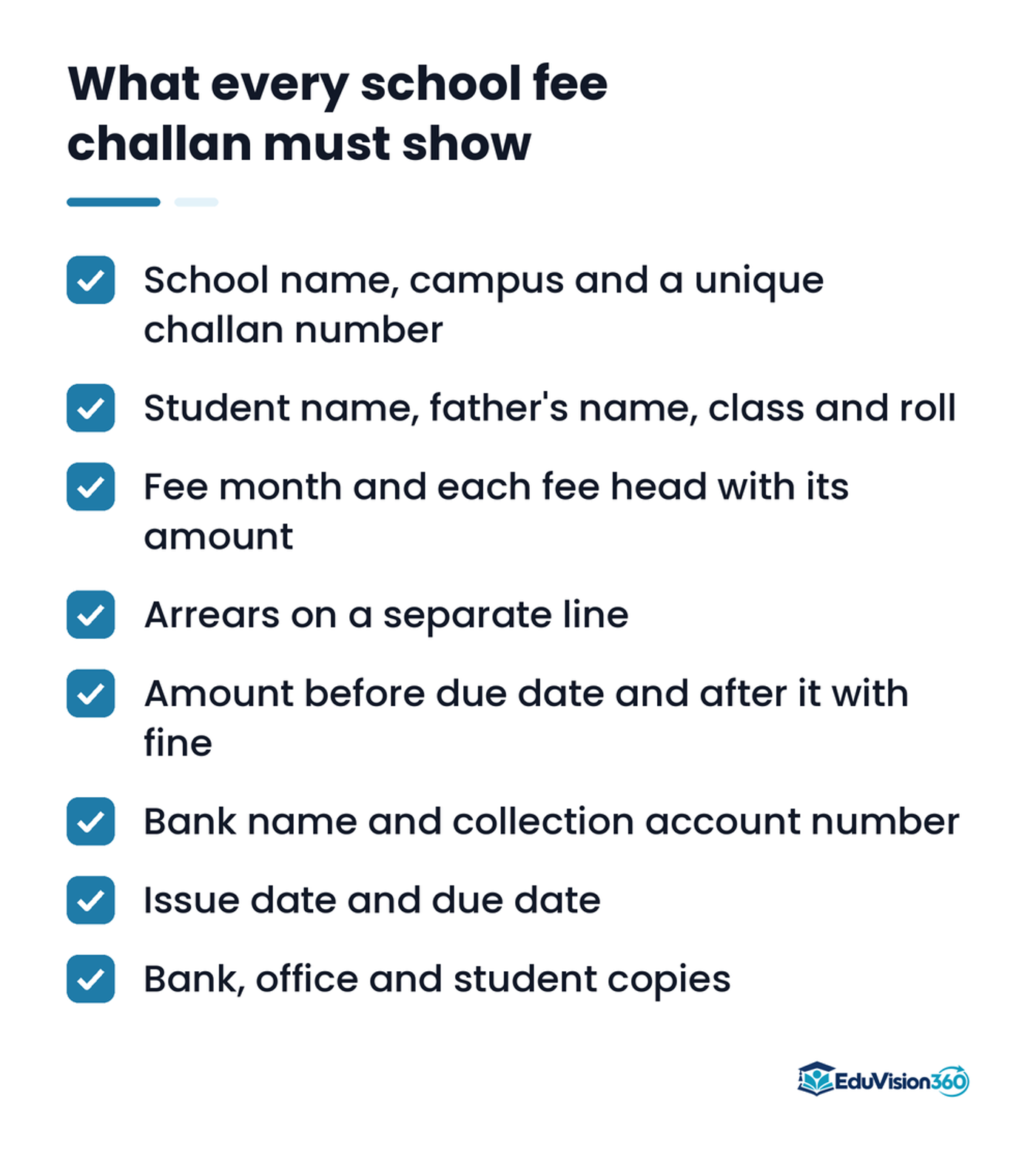
A school fee challan must show who is paying, what for, how much, by when, and where to pay. Missing any one of these leads to a wrong deposit or a parent at the counter arguing about the amount.
- School name, campus and logo
- Challan number (unique, so the payment can be matched later)
- Student name, father's name, class, section and registration number
- Fee month or period (one month per challan where your regulator requires it)
- Fee heads with amounts: tuition, admission, exam, transport and so on
- Arrears from earlier months, shown on their own line
- Amount payable by the due date, and the amount payable after it with the late fine
- Bank name, branch and collection account number
- Issue date and due date
- Space for the bank's stamp and signature on each copy
A challan is a payment instruction, not a receipt. As the OpenEduCat tool itself states, a printed challan is "not proof of payment"; proof comes from the bank's stamp or a receipt the school issues after the money is recorded.
Do fee rules in Pakistan affect how you make challans?
Yes. Some regulators now set rules that change what a challan may contain, so check your own province before you design one.
- Sindh: for the 2026-27 session, schools that collected June and July fees in advance had to issue separate fee vouchers for each month, with the June voucher valid until 30 June and the July voucher until 31 July. Matric students could be charged only up to March.
- Islamabad: PEIRA allows private schools to collect only one month's fee in advance, so a challan that bundles several future months can breach the rule.
A generator that only prints one combined amount makes these rules hard to follow. You want one challan per month, with arrears shown separately from the current month's fee. Our guide to private school fee rules in Pakistan covers each province in more detail.
Free challan template or fee software: which should you use?
A free template works for a small school with flat fees and a few dozen students; fee software is worth it once you have discounts, siblings, arrears or more than one class to bill each month. The table shows where each one stands.
| Task | Free template / Excel | Fee software |
|---|---|---|
| Fill student details | Typed by hand | Taken from student records |
| Arrears | Worked out by hand | Carried forward automatically |
| Late fine | Added by hand | Printed as a second amount |
| Whole-school print run | One challan at a time or mail merge | One class or all classes at once |
| Matching payments | Tick off in a register | Recorded against the challan number |
| Defaulter list | Built by hand | Report by class or school |
The real cost of a template is not the printing. It is the accountant's time each month and the mistakes that follow: a missed arrear, a discount applied twice, a sibling billed at the wrong rate. If you already keep fees in a spreadsheet, see when to move from Excel to software for the signs that it has stopped working.
How to make fee challans for the whole school each month
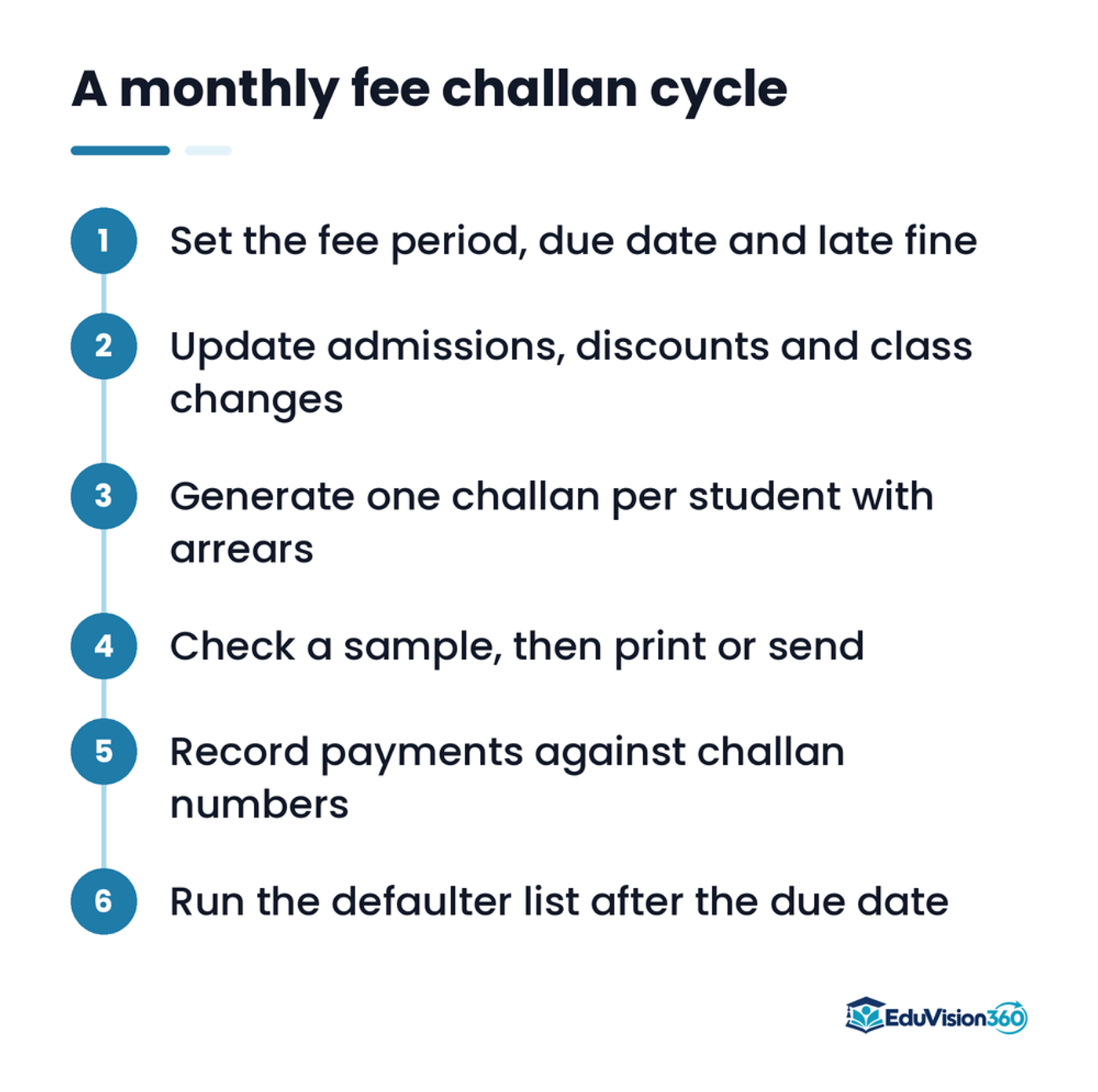
The cleanest monthly cycle is the same whatever tool you use: set the period, generate, check, print or send, then record payments against challan numbers.
- Set the fee period. Name the month, the due date and the late fine. Keep the fine flat and written in your fee policy so parents can check it.
- Update the fee plans. Enter new admissions, withdrawals, discounts and class changes before you generate anything.
- Generate the challans. Create one challan per student for the month, with last month's unpaid balance carried as arrears.
- Check a sample. Open five challans from different classes, including one sibling family and one student with a discount, and check every amount.
- Print or send. Print the three-copy challans, and send the parent copy digitally where you can.
- Record every payment. Mark each paid challan from the bank's stamped copy or deposit report, by challan number, within a day.
- Run the defaulter list after the due date. Remind those parents and carry their balance into next month's challan.
Print the challan number as a barcode if your tool supports it. Scanning the barcode at the fee counter is faster than typing the number and removes a common source of wrong entries.
For more ways to get paid on time, read how to collect school fees on time, every month.
Can parents pay a challan without going to the bank?
Yes, if your school's challans are set up for an online bill channel. 1Bill, run by 1LINK (Pakistan's payment switch), lets billers including education institutions collect payments through bank channels and at bank counters, using a customer or bill number with the biller's own prefix.
For a school this means the same challan can be paid at the bank counter as before, or from the parent's banking app. Our comparison of online fee collection methods for schools explains the other options and how they compare.
How EduVision360 generates fee challans
EduVision360 is a school management system in Pakistan that generates fee challans for one student, a class or the whole school from each student's fee plan, with arrears and late fines already calculated.
What it does with challans:
- Bank-style challans with office, bank and student copies side by side, each with a barcode.
- Two amounts on every bill: the amount payable before the due date and the amount after it, with the late fine added. The fine is one flat charge per unpaid month and never compounds.
- Arrears carried forward from unpaid months automatically.
- Family challans that put all siblings, grouped by the parent's CNIC, on one challan; plus blank challans, three students per page, and thermal printer slips.
- Parent copies on WhatsApp and in the parent app, where parents can download their challan or receipt as a PDF.
- 1Bill payment: parents can pay EduVision360 challans through 1Bill from their bank's mobile app or internet banking, and the fee is marked paid automatically. They can still pay at the bank with the printed challan or at the school counter.
- Defaulter reports by class or school, and WhatsApp reminders you send to those parents in bulk.
See the full fee features on the school fee management software page. Plans start from Rs 20 per student per month, with free setup and data import; see pricing for details.
Frequently asked questions
Is a free fee challan generator good enough for a school?
A free generator is fine for designing your challan format or for a very small school with fixed fees. Once you have arrears, discounts, siblings or several classes to bill every month, filling each challan by hand takes hours and causes mistakes, and fee software becomes the faster option.
How many copies should a school fee challan have?
Most Pakistani school challans have three copies on one sheet: a bank copy, an office copy and a student copy. The bank keeps its copy, the school keeps the office copy for its records, and the parent keeps the stamped student copy as proof of payment.
Is a fee challan the same as a fee receipt?
No. A challan tells the parent what to pay, by when and where; a receipt confirms the money was received. The stamped bank copy or a receipt issued by the school after recording the payment is the proof, not the printed challan itself.
Should one challan cover several months of fees?
Check your regulator first. Sindh required separate fee vouchers for each month when June and July fees were collected early in 2026, and PEIRA in Islamabad allows only one month's fee in advance, so one challan per month is the safer default.
Can a challan show a late fine?
Yes. The clearest way is to print two amounts: the fee payable by the due date and the fee payable after it with the fine added. Parents then know the exact amount on either date, and the bank does not have to calculate anything.
Make your next challan run the last manual one
If your accountant still types challans one by one, a fee system can produce the whole month's challans, with arrears and fines, in minutes. Book a free EduVision360 demo and we will show you a challan run with your own fee heads, or message us on WhatsApp.